New report also shows that college and university employees with low financial literacy face many economic struggles
NEW YORK (October 24, 2022) – College and university employees with greater financial literacy tend to experience better financial well-being than peers with low financial literacy, highlighting the value of campus programs to improve personal finance knowledge, according to a new joint report issued by the TIAA Institute and the College and University Professional Association for Human Resources (CUPA-HR).
Financial literacy was gauged by asking workers five questions about fundamental economic concepts, "the Big 5": such as interest rates, inflation, risk diversification, mortgages, and bond pricing. Financial literacy among full-time college and university employees compares favorably with that of U.S. adults in general but is nonetheless low for many. Forty-one percent of higher education employees correctly answered four or five questions compared with 32% of U.S. adults. On the other end of the spectrum, 33% of higher education employees could correctly answer only up to two of the questions, according to the report.
"Younger employees tend to have lower financial literacy – 39% of those under 40 correctly answered two or fewer questions," said Paul Yakoboski, senior economist at the TIAA Institute. "This latter data point is particularly troubling as many consequential financial decisions are faced early in life, decisions with ramifications for financial well-being decades into the future, as well as the present."
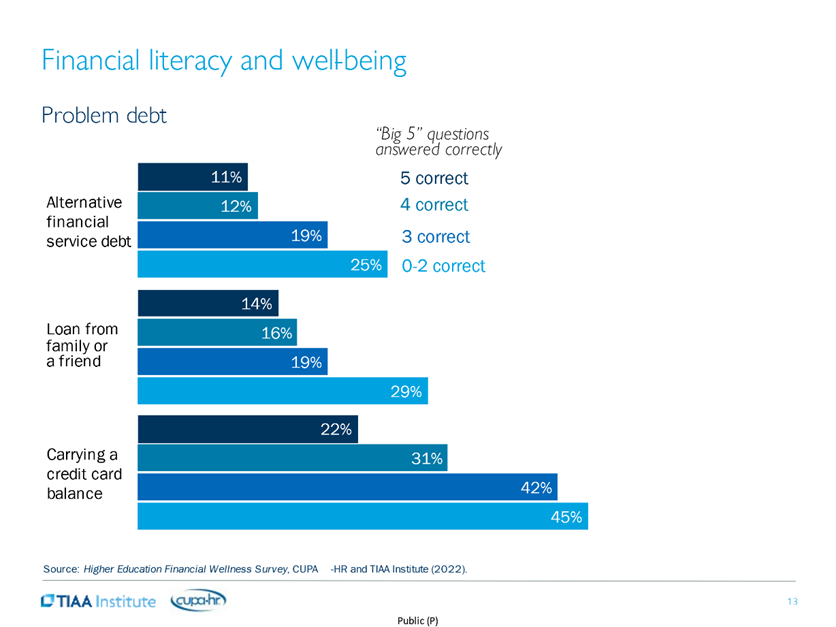
"Higher ed employees with very low levels of financial literacy are over three times more likely to be significantly debt constrained and three times more likely to lack one month's worth of emergency savings," said Melissa Fuesting, senior survey researcher at CUPA-HR. "These findings signal the importance of financial literacy programming in employer financial well-being initiatives—financial literacy impacts the range of decision making encountered in individuals' financial lives."
Consistent with previous research regarding the relationship between financial literacy and financial well-being, greater financial literacy among college and university employees generally translates into greater financial well-being, and lower financial literacy is generally associated with lower financial well-being.
Higher education employees with a very low level of financial literacy are:
- Over two times more likely to have difficulty making ends meet
- Almost three times more likely to spend ten hours or more per week thinking about and dealing with issues and problems related to personal finances
- Over twice as likely to carry alternative financial service debt
- Twice as likely to have a loan from a family member or friend
- Twice as likely to carry credit card debt unpaid from previous bills