Only about half of small businesses offer a retirement plan, leaving millions of workers without access to employer-sponsored retirement savings. This Research Dialogue examines why small employers lag behind on retirement plan sponsorship—and what it would take to close the gap.
Summary
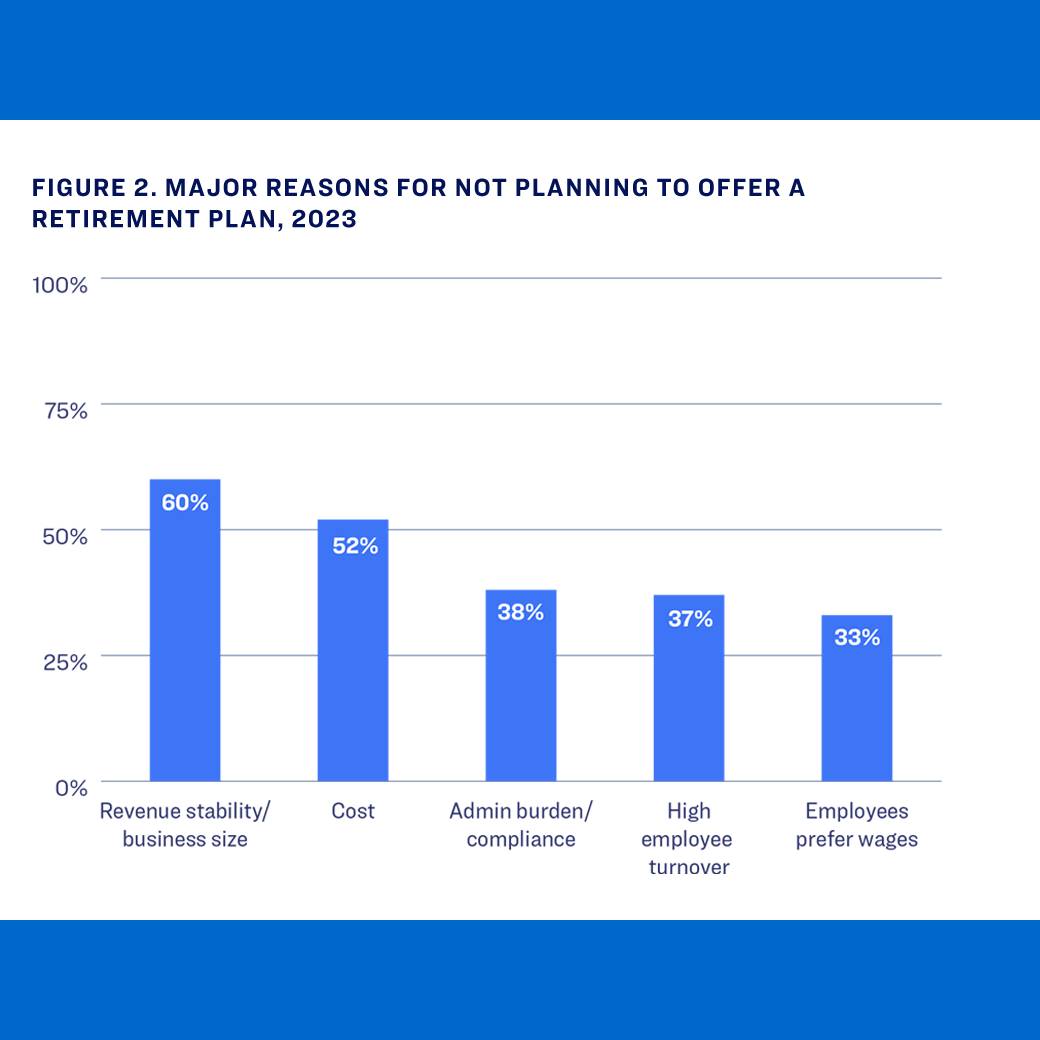
Small businesses account for nearly all U.S. firms and employ roughly one-third of private-sector workers, yet only 53% of the smallest firms offer a retirement plan compared to 91% of large employers. Drawing on surveys, regression analyses, and policy research from the Center for Retirement Research at Boston College, this brief finds that the barriers small employers face when deciding to sponsor a retirement savings plan. Many overestimate the costs and administrative burden of offering a plan while underestimating its value for recruiting and retaining workers. Employers who have accurate information and receive practical support are substantially more likely to adopt a plan. Trusted intermediaries such as accountants, payroll providers, and financial advisors can play an important role, though they themselves often share common misperceptions about plan costs. While state mandatory auto-IRA programs have shown some early promise as well as recent SECURE 2.0 incentive provisions expanding retirement coverage for small-business workers will require a combination of clear information, trusted guidance, and straightforward pathways to plan adoption.
Key Insights
- Coverage gaps begin with small employers. Only 53% of firms with fewer than 50 employees offer a retirement plan, compared to 91% of firms with 500 or more employees, making small businesses the primary driver of the nation's retirement coverage gap.
- Most small firms don't know help is available. Only 24% of small employers are aware of the tax credit of up to $5,000 per year for three years to offset the cost of starting a plan—yet 78% say such a credit would make offering a plan more attractive.
- Business maturity matters as 87% of business offer a plan in their 10th year compared to half in their first five years of operation. This suggests financial stability and business growth are key turning points for plan adoption.
- State auto-IRA programs are gaining traction. As of 2026, 15 states have mandatory auto-IRA programs in operation, with more than 1.2 million funded accounts.
- Trusted advisors can help—but need better information themselves. Accountants, bankers, and other professional service providers can meaningfully influence plan adoption, but more than one-third overestimate plan costs, which may unintentionally discourage the small employers they advise.