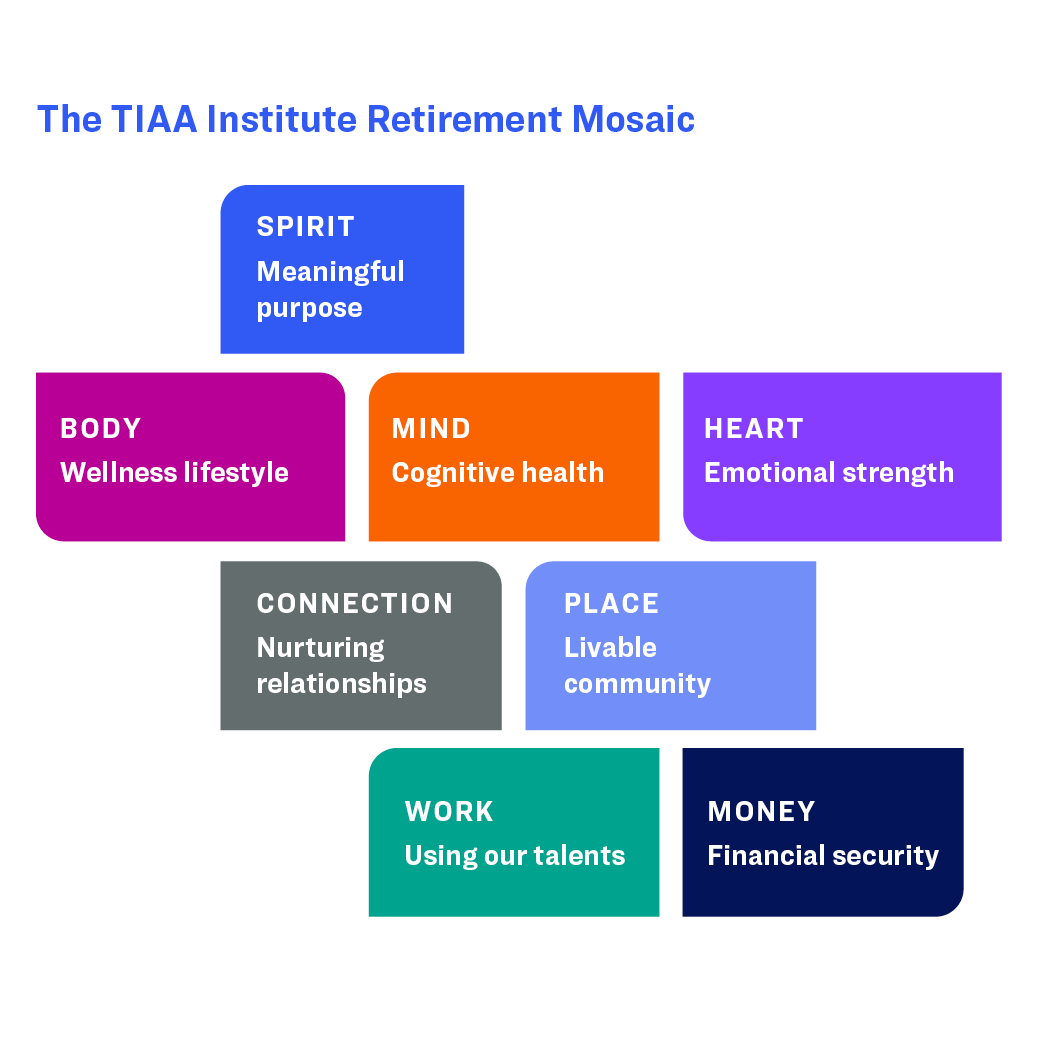
Advances in medicine, nutrition, and public health mean Americans are living longer than ever. Laying the ground work for a truly fulfilling retirement requires far more than financial preparation. The TIAA Institute Retirement Mosaic offers a research-based planning framework to help individuals thrive across all dimensions of a longer life.
Summary
The TIAA Institute Retirement Mosaic, authored by TIAA Institute Fellow Maureen Devlin and Anne Ollen, presents a holistic framework for retirement planning built around eight interconnected components: Spirit (meaningful purpose), Body (wellness lifestyle), Mind (cognitive health), Heart (emotional strength), Connection (nurturing relationships), Place (livable community), Work (using our talents), and Money (financial security). Grounded in the concept of longevity fitness, the report draws on leading research to demonstrate that a good retirement depends on how closely an individual's lifespan, healthspan, and wealthspan are aligned. Each component of the mosaic offers practical, research-backed guidance and highlights the powerful interconnections across all eight dimensions, making the case that intentional effort across these compoents is essential to living a long, engaged, and satisfying retirement.
Key Insights
- Longevity is increasing, and so is the challenge of planning for it. In 2023, a 65-year-old woman could expect to live nearly 20 more years on average, and a 65-year-old man more than 17 years, both significantly more than a century ago.
- Purpose matters for more than happiness. A National Institute of Aging study found that older adults scoring in the top 10% on purpose in life were 2.4 times more likely to remain free of Alzheimer's disease than those in the bottom 10%.
- Retirement and Work are not mutually exclusive. Research shows that retirees who engage in bridge employment or volunteer work report higher life satisfaction, improved cognitive functioning, and even measurable reductions in the pace of biological aging.
- Americans with demonstrated retirement fluency—knowledge of Social Security, Medicare, lifetime income, and savings strategies—are nearly four times more likely to report confidence in their ability to live comfortably throughout retirement.
- Social connections are a health imperative. Retirees who maintained at least two group memberships faced a 2% risk of death in the first six years after retirement, compared to a 12% risk for those who lost both group connections.