Retirement planning can be complex, but a simple metric may help cut through the noise. This research explores how the asset-salary ratio (ASR) can serve as an accessible, actionable tool for workers to assess whether they are on track to meet their retirement income goals.
Summary
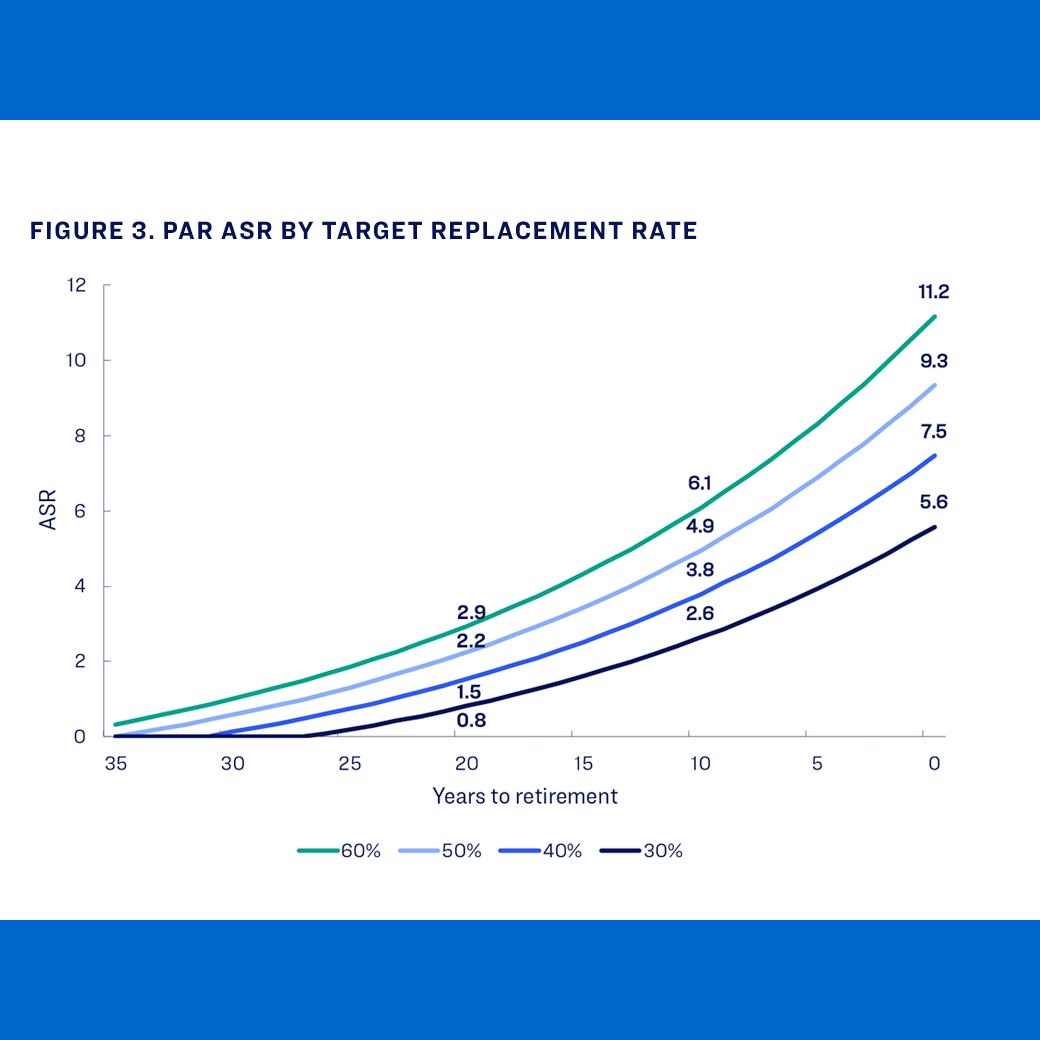
This paper examines the asset-salary ratio (ASR), a worker's accumulated retirement assets divided by their current salary, as a straightforward measure of retirement readiness. The authors translate the ASR into a "Par ASR," or target ratio needed at any given point in a career to meet an 80% income replacement rate in retirement, assuming Social Security covers 30% and workplace savings cover the remaining 50%. Using a composite retirement income strategy that combines fixed annuities, variable annuities, and liquid cash withdrawals, the paper establishes a Par ASR of 9.3 at retirement, meaning a worker needs accumulated savings roughly 9.3 times their final salary. The authors conduct sensitivity analyses showing how changes in savings rates, investment returns, salary growth, and retirement timing affect outcomes, and evaluate historical ASR results across four worker cohorts from 1976 to 2022. Across all cohorts, workers who saved consistently for 35 years at a 10% contribution rate met or exceeded the Par ASR target, underscoring the power of long-term, consistent saving.
Key Insights
- A simple benchmark for retirement readiness. On average, workers need accumulated retirement savings of approximately 9.3 times their final salary, an ASR of 9.3, to achieve an 80% income replacement rate in retirement when combined with Social Security.
- Starting early matters enormously. Delaying the start of saving by just 10 years (from 35 years before retirement to 25 years) requires nearly doubling the contribution rate, from 10% to 18.9%, to reach the same retirement income target.
- Investment strategy significantly impacts outcomes. Shifting to an overly conservative portfolio with 4% expected returns instead of 8%, even when above Par ASR, could require contribution rates as high as 24% to stay on track, highlighting the risk of being too conservative too early.
- Working longer is a powerful lever. A worker with an ASR below target just five years before retirement may need to work only 1.5 additional years, rather than make dramatic contribution increases, to achieve an 80% replacement rate, thanks to higher Social Security benefits, better annuity payout rates, and continued investment growth.
- Historical data offers encouragement. Across four worker cohorts spanning 1976 to 2022, all workers who saved 10% consistently for 35 years using a target-date glide path exceeded the Par ASR target at retirement.