As health systems race to adopt AI across clinical and operational use cases, this report examines what's driving momentum, what's holding progress back, and what it takes to move from early promise to proven, scaled results.
Summary
U.S. health systems are confronting rising costs, workforce shortages, and an aging patient population, and they are increasingly turning to AI as part of the solution. Adoption is accelerating rapidly, with the share of health systems having implemented generative AI more than doubling in two years, and leaders, physicians, and nurses alike expressing optimism about AI's potential to improve care, ease administrative burden, and strengthen financial performance. Yet most AI initiatives still stall before reaching full deployment, and stakeholders, including patients, especially those 50 and older, raise real concerns about accuracy, privacy, and the impact on care relationships. This report explores the diverse landscape of AI use cases spanning clinical care and health system operations, the financial and workforce implications of these tools, and the organizational readiness factors that separate health systems successfully scaling AI from those stuck in pilot purgatory.
Key Insights
- AI adoption is accelerating sharply, with 52% of health systems having implemented generative AI by late 2025—up from just 25% two years prior.
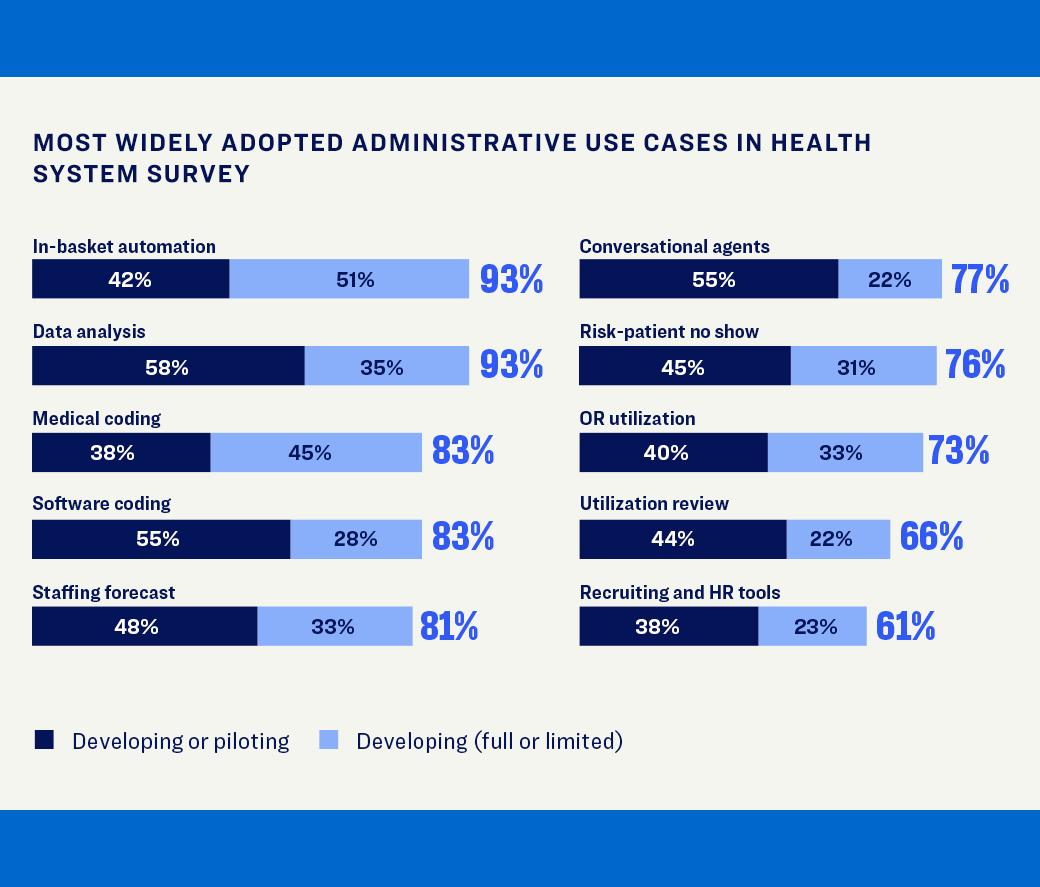
- Clinical and administrative use cases vary widely in maturity: radiology/imaging is nearly universal (90% deployed), while most of the 36 use cases studied remain in development or pilot stages.
- Despite high expectations, most AI projects struggle to scale, as only 35% of AI proof-of-concepts advance into full production.
- Stakeholder views differ by role: health system executives, physicians, and nurses report broadly positive outlooks on AI's potential, while concerns persist around accuracy, privacy, and cybersecurity.
- Successful scaling requires readiness across four domains: strategic, technical, workforce, and mission alignment—not just promising pilot results.