As artificial intelligence advances and populations age at an unprecedented pace, two of the biggest forces in human history are converging. This TIAA Institute report examines what that convergence means for how people live, work, and age.
Summary
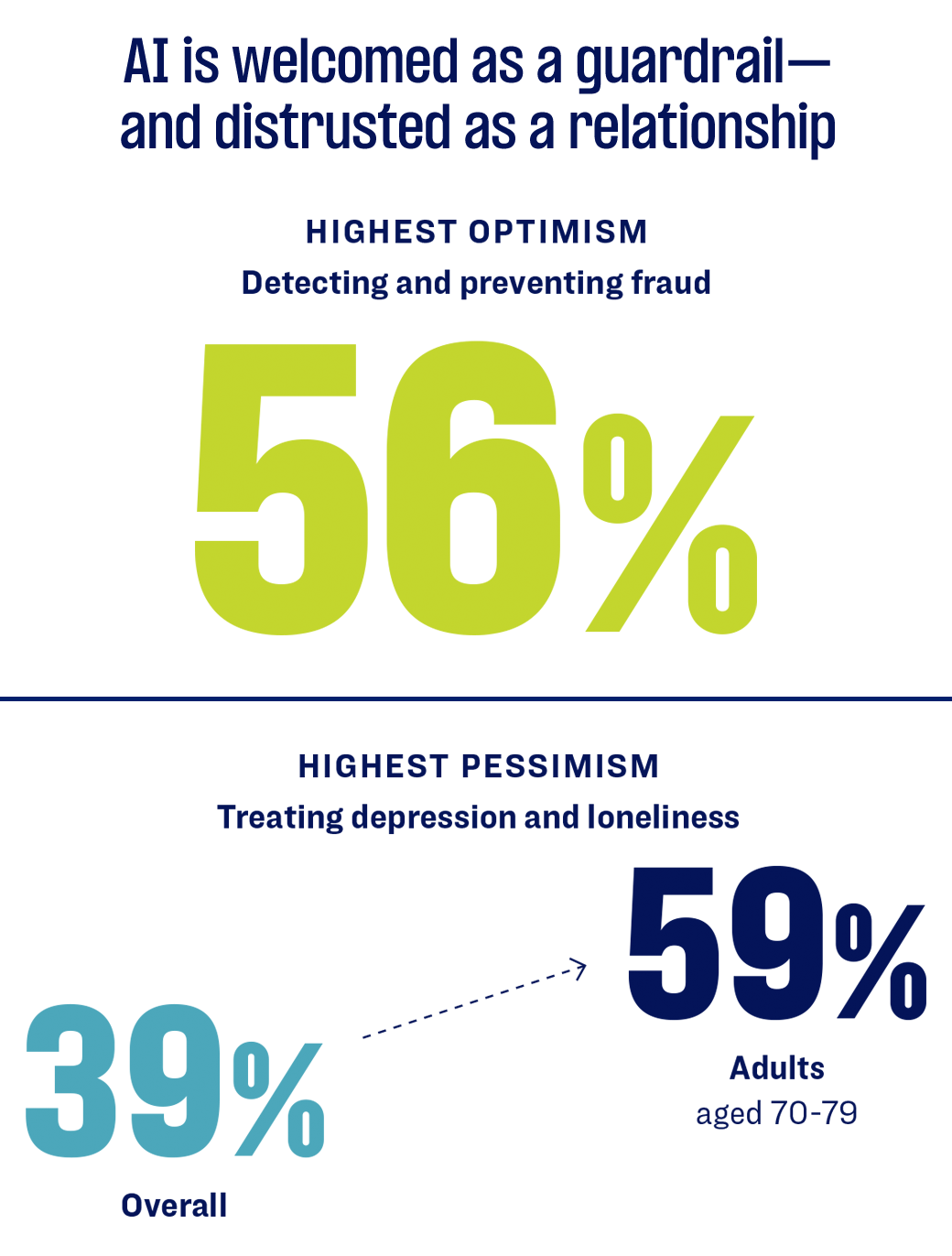
This report explores the intersection of AI and longevity, two megatrends reshaping what it means to grow older. It finds that AI's benefits and risks for an aging society are deeply intertwined: AI is already improving financial guidance, medical diagnostics, and administrative support, while simultaneously fueling sophisticated elder fraud, embedding bias into hiring and lending decisions, and straining trust across generations. The report examines these dynamics across five domains: finances and data security, work and life-course learning, health and cognition, family and caregiving, and the risks that cut across all of them. Its central finding is that older adults consistently welcome AI when it functions as a safeguard, such as fraud detection, but remain skeptical when AI is positioned to replace human judgment or relationships, such as in mental health support. The report closes with recommendations for industry, policymakers, and communities to ensure that longer lives, powered by AI, become a dividend rather than a tax.
Key Insights
- The paradox of longevity – We are rapidly developing the technical capability to help older adults, but we lack the institutions, governance, and structures to deploy it responsibly.
- AI is democratizing high-quality financial guidance once reserved for the wealthy: 85% of financial advisors surveyed by the World Economic Forum attribute client wins to advanced AI-driven capabilities.
- Older adults trust AI most when it acts as a protective guardrail. Fraud detection is the only AI use case to earn majority public optimism, at 56%, showing that older Americans are genuinely receptive to AI when it's designed to safeguard rather than replace human judgment.
- Elder fraud is intensifying alongside AI adoption. Losses reached $4.9 billion in 2024 (up 43% year over year) and could climb toward $40 billion by 2027 under high-adoption scenarios for generative AI-enabled fraud.
- AI hiring tools risk compounding age discrimination. Reported age-discrimination complaints rose sharply in 2025 as automated screening adoption grew among employers, with studies finding AI systems can systematically undervalue older and female candidates.