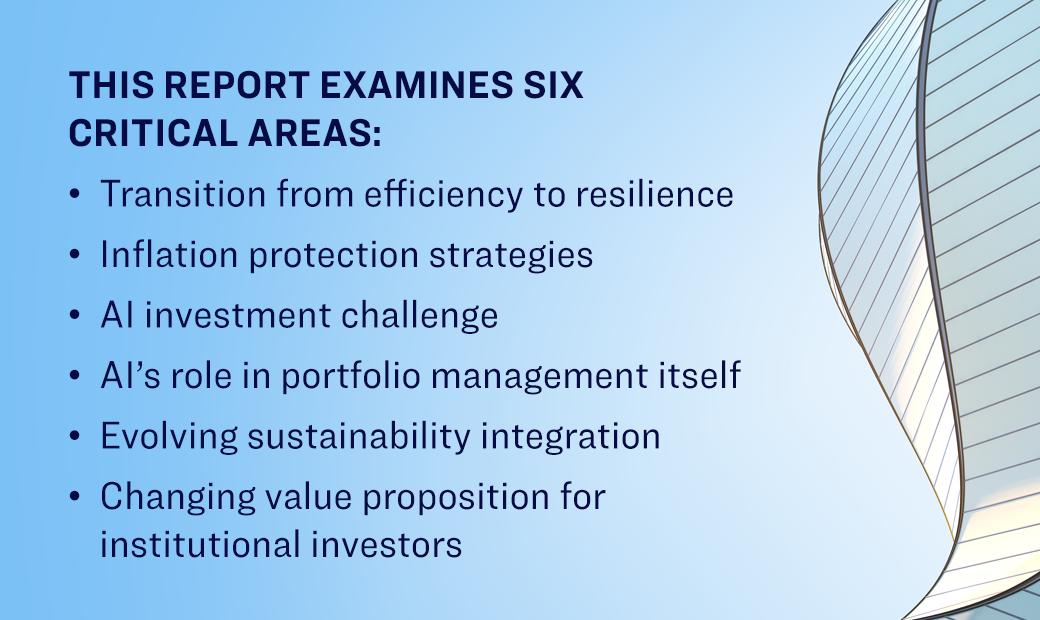
This research examines how institutional investors are navigating a convergence of structural forces reshaping global markets, including population aging, elevated government debt, geopolitical fragmentation, and rapid technological advancement. Drawing from interviews with chief investment officers across American, European, Australian, and Asian institutions, the report identifies key challenges and strategies for building resilient portfolios in an increasingly complex environment.
Summary
Institutional investors face a fundamentally different operating environment than the 2010s, marked by the erosion of post-war alliances, persistent inflation pressures from deglobalization and aging populations, and transformative yet uncertain AI developments. Country risk has returned to developed markets as fiscal sustainability concerns emerge alongside questions about the dollar's long-term role as reserve currency. While AI promises productivity gains, uncertainty about value capture persists, leading investors to experiment cautiously while integrating AI tools into their own operations. Sustainability has evolved from standalone mandates to pragmatic integration of material risk factors, with private markets increasingly essential for customized portfolio construction. Institutional investors now face mounting pressure to justify their value proposition beyond simple market exposure, demonstrating sophisticated capabilities that individual investors cannot replicate while maintaining accountability to stakeholders demanding transparency about holdings and strategy. The investors equipped to succeed in this environment will be those who engage seriously with these shifts, invest in understanding rather than reacting to headlines, and maintain conviction in their ability to adapt thoughtfully to whatever emerges.
Key Insights
- Efficiency makes way for resilience: The shift from globalization to regional resilience is increasing costs and volatility, with country risk premiums returning to developed markets after years of dormancy.
- Inflation protection imperative: Elevated debt levels, aging populations, and deglobalization point toward higher and more volatile inflation, driving demand for assets offering both growth potential and inflation protection.
- AI uncertainty demands experimentation: While consensus exists that AI will be transformative, profound uncertainty about who will capture economic value leads investors to experiment while maintaining long-term discipline.
- Sustainability becomes pragmatic: Environmental, social, and governance factors are now integrated as material risk considerations rather than ideological mandates, with energy transition investments viewed as significant capital deployment opportunities.
- Accountability pressure intensifies: Democratization of investing forces institutional investors to justify their value beyond compliance with mandates, demonstrating capabilities individuals cannot replicate.